Description
Modern Admissions
Modern Admissions
Delivering a first-class service to millions.
Admissions is the heart of our service. Each year, we support over 700,000 applicants explore 50,000 undergraduate courses across 360+ universities and colleges, resulting in over half a million students starting their studies.
In 2022, almost 50% of all 18 year olds in the UK population looked to UCAS for support. In addition to our personalised careers information, advice and guidance on the full range of pathways available, we respond to half a million direct queries, guiding students through the admissions process as they seek and secure their course of choice.
We continue to reform the way students explore and connect to choices. Our Reimagining UK Admissions report and subsequent consultation response, informed by the voices of 13,000 students, outlined an ambitious vision for how the current system can be improved to the benefit of all stakeholders, improving choice and supporting social mobility.
What our customers told us:
90% of applicants are satisfied with their UCAS experience.
Students said they value the personal statement as the moment they can articulate their ambition in the application, but 79% agreed it can be difficult to write.
Teachers and advisers have told us the current process could be improved, with guidance on what information is of value to universities and colleges.
Providers told us their priorities for UCAS are providing more contextual information on the applicant and improving admissions processes to drive efficiencies.
Providers want to be able to better target specific cohorts of applicants during Clearing, based on their individual needs.
Clearing Plus matches unplaced applicants with your courses, based on their preferences, and your requirements. Since then, we have used customer feedback to add more features, allowing providers to target applicants based on the UCAS Tariff and mixed qualifications. This year, we emailed daily Clearing Plus matches to unplaced applicants throughout the whole Clearing period. Over 4,500 applicants were placed at a provider using Clearing Plus in 2022.
Verification plays a crucial role in protecting students and providers from fraudulent applications. Each year, our team protects universities and colleges from spending their valuable time reviewing disingenuous submissions.This year, we’ve reviewed 36% more cases than last year, identifying and dismantling a number of new fraud rings with shared characteristics.
In 2021/22, over three million results and amendments were processed – half a million more than in 2020.
The RPA process allows providers to record students who applied directly during Clearing with UCAS. We have made this process more efficient – with one central place for reporting along with the ability to report on RPAs individually and in bulk, ensuring a complete record each year of all undergraduate admissions.
This allows more flexibility and relieve some pressure points. This included the consolidation of in-cycle ‘reply by default’ and ‘decline by default’ dates, and moving the January equal consideration application deadline to later in the month, allowing more time to support students after the Christmas break. These changes have now been made permanent, to allow students to be supported at these crucial points in the cycle.
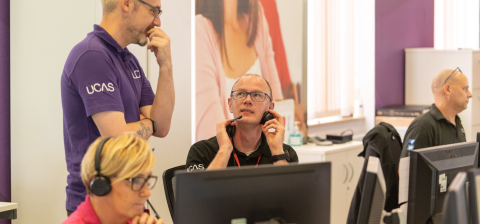
Our programme to reform admissions is essential to keep up with the constant changes in policy and behaviour. Customer needs are continually transforming our products and services, so they remain relevant:
We spoke to schools and universities, and found some disparity between how they approached the information the reference provides on an applicant. The agreed solution – changing free text to set questions – removes the guesswork. Providers will have confidence in the value of references, and advisers will get a return on their time.
Both students and universities have told us that, just like referencing, a set question format would result in quicker, better personal statements. We are consulting on making this change.
Is the insurance choice useful? Are students stretching their time too thinly? Do they want, or need, fewer than five options? Do we need to change?
So they can spot the tell-tale signs of fraudulent applications and provide an extra layer of vigilance.
So our admissions system includes and accepts alternative, non-standard qualifications.
Based on input and feedback from providers. This will make it easier for providers to present a wider range of full-time, part-time, modular and distance learning courses, set up joint courses, and separate course data into marketing and admissions information.
Responsible for processing results and amendments from awarding organisations and transferring those to providers. These enhancements, which include automating processes and overhauling the underlying reference data to create a single source of qualifications truth, will make the service more efficient and robust, and give it potential for future expansion to encompass a wider range of qualifications.